
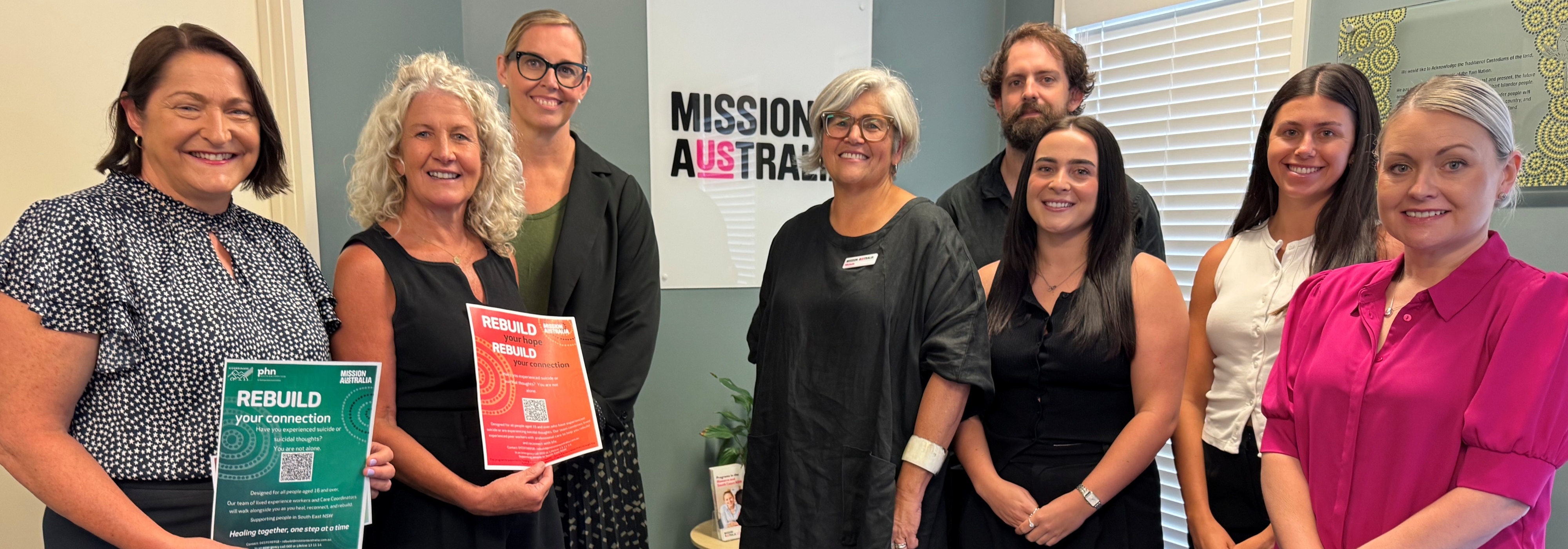
Rebuild service’s first year highlights value of tailored support for people experiencing suicidal distress
12 November 2026
The Rebuild program’s first year of operation, supporting more than 170 people following a suicide attempt or suicidal crisis in South Eastern NSW, highlights how the right support can help people take steps toward healing and hope.
Prudence Buist, CEO of COORDINARE - South Eastern NSW PHN said recent feedback from consumer focus groups provides insight into how participants experienced Mission Australia’s Rebuild service including feeling heard, calmer, less overwhelmed and reassured.
"More than 50 per cent of people who die by suicide do not interact with the public health system in the year prior to death, highlighting the importance of finding new ways to reach people in distress," said Ms Buist.
"We expanded Universal Aftercare services in the region a year ago in response to identified needs, including a need for expanded face-to-face support in the Shoalhaven and Goulburn–Mulwaree regions and a need to reach people experiencing suicidal distress who don’t present through traditional health services. Recent feedback demonstrates how the right support is helping people take those first steps toward healing and hope.
"Consumers who participated in Mission Australia’s recent focus groups in Nowra and Goulburn described Rebuild as a safe, respectful and person-centred service. Participants valued the non-clinical support available through Rebuild and described feeling supported to address challenges affecting their wellbeing," said Ms Buist.
Rebuild and Grand Pacific Health (GPH)'s Next Steps program are COORDINARE’s commissioned Universal Aftercare services in South Eastern NSW. Both services provide tailored support based on an individual’s needs and goals for up to three months. To help address factors contributing to suicidal distress and support recovery, Care Coordinators and Peer Workers help clients develop support and safety plans and connect with formal or informal supports aligned to their goals.
Program Manager Michele Lanigan said the lived experience of Peer Workers is a defining strength of Rebuild, providing understanding, hope and genuine connection.
Focus group participants particularly valued the flexibility of support and communication.
“Support with immediate pressures like housing, health, legal, financial and everyday concerns enable individuals to focus on safety, wellbeing, recovery and purpose, plus activities and ways to reconnect with their community,” said Ms Lanigan.
“We are grateful to those who participated in the focus groups for their honest feedback and constructive suggestions to further improve the service. The feedback identified opportunities to further strengthen the service, including transition planning in the weeks before exiting the program, follow-up support and ongoing connection options, clearer information about available supports and timely access to other services,” she said.
The introduction of Rebuild one year ago represented an expansion of Universal Aftercare support across South Eastern NSW, complementing the existing Next Steps service and allowing targeted focus on previously underserved communities. Between 2024-25 and 2025-26, face-to-face support in Shoalhaven and Goulburn Mulwaree grew with the proportion of all Universal Aftercare consumers from these communities increasing from 15.2% to 29.6%. Reach also increased among groups disproportionally impacted by suicide, with the number of Aboriginal and Torres Strait Islander consumers increasing from 14 to 40, and men aged 45–64 years from 24 to 75.
Universal Aftercare services are guided by the NSW Agency for Clinical Innovation’s Universal Aftercare Service Delivery Model and are designed to be flexible and person-centred. Funding for aftercare services is provided under the bilateral and co-funding agreement between NSW and Commonwealth governments.
COORDINARE is committed to strengthening mental health and suicide prevention services across South Eastern NSW, and to supporting collaboration between experienced local providers, Illawarra Shoalhaven Local Health District and Southern NSW Local Health District to strengthen coordinated care and referral pathways.
To access Rebuild, email Rebuild@missionaustralia.com.au or phone 0459 598 958.
To access Next Steps, email gphnextsteps@gph.org.au or phone 0475 762 915.
For service coverage and access information, view COORDINARE’s Universal Aftercare Flyer.
Refer to mindframe.org.au for support and advice on reporting of suicide-related stories.
Additional support details:
If you, or someone you are with, is in immediate danger call 000.
If you are feeling distressed and in need of assistance, please contact:
- Lifeline: 13 11 14
- Suicide Call Back Service: 1300 659 467
- 13YARN: 13 92 76
- Beyond Blue: 1300 224 636
- Men's line: 1300 78 99 78
- Veteran's Line: 1800 011 046
- Qlife: 1800 184 527
- Kids helpline: 1800 55 1800
Support for those impacted by suicide loss is available from StandBy Support After Suicide (24/7, phone 1300 727 247) and Thirrili Indigenous Postvention Support (24/7, phone 1800 805 801).
Minds Together - a free online program for family, friends, carers and kin who are supporting someone following a suicide attempt or experiencing suicidal distress.
Caption: Launching the Rebuild program (from left) MPs Fiona Phillips and Liza Butler, COORDINARE CEO Prudence Buist, Mission Australia program manager Michele Lanigan, care co-ordinator Rourke Armstrong, Mission Australia area manager Helen Fuller, care co-ordinator Rianna Steel and peer workers Ella Davidson and Meg Tanner.